Underwater Treadmill vs. Hands-On Canine Physical Therapy: When Does Each Help?
Underwater treadmill can be useful in selected rehabilitation phases, including assisted weight-bearing and gait training. Individualized assessment, progressive land-based strengthening, balance and functional exercises are also important. The appropriate combination and timing depend on diagnosis, surgery, pain, mobility, veterinary guidance and clinician judgment—not a rule that one approach is always better.
This is general education, not an exercise prescription or clearance for activity. Canine Sapien currently provides mobile hands-on and land-based physical therapy; Dr. TJ does not have an underwater treadmill.
The useful question is not “water or hands-on therapy?” but “what does my dog need to move more comfortably and safely?” An aquatic appointment may include hands-on care, and a land-based plan may be coordinated with aquatic treatment elsewhere.
A clinician starts with history, movement, comfort and your goals. Treatment is selected and reassessed against those needs. Purdue’s rehabilitation service describes a combination of exercises and modalities rather than a single piece of equipment. [4]
For a dog gait rehabilitation plan, supported steps in water and walking at home answer different questions. What a dog can do in one setting does not automatically establish readiness in another.
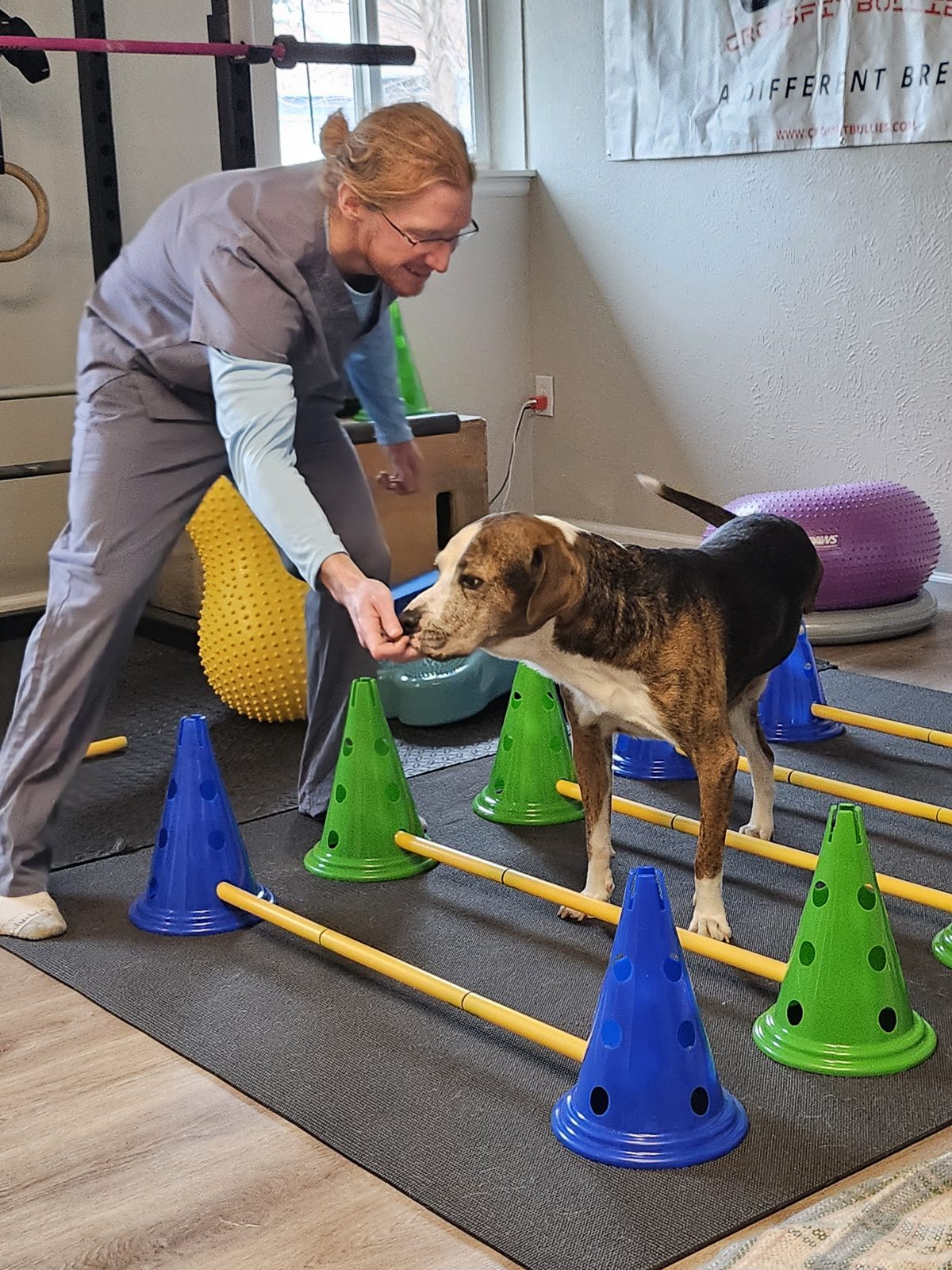
Land-based movement work is selected around the dog’s needs and everyday function.
What changes in water?
Buoyancy, resistance & walking mechanics
Support from buoyancy
Water’s buoyancy can reduce the weight a dog bears while moving. The amount of support depends partly on water depth, which is why assisted weight-bearing may be one reason a professional considers water exercise. It does not make every setting suitable for every injured dog. [1]
Resistance & demand
Moving through water introduces resistance. Water depth and treadmill speed affect the exercise conditions; more challenge is not automatically better. A study in healthy dogs measured changes in muscle-activity signals under different conditions, not faster healing in patients. [3]
A different walking task
Underwater treadmill walking uses a moving belt while the dog is immersed. It differs from swimming and from walking on land. A small healthy-dog study found that water level changed joint motion; it did not identify a universally best depth for rehabilitation. [2]
These mechanisms help explain why aquatic therapy is considered. They do not, by themselves, prove clinical superiority or guarantee an outcome.
Different strengths · Shared clinical judgment
Water-based work and hands-on / land-based care
These approaches can complement one another. This is a comparison of tasks and considerations, not a ranking of providers or a prescription for your dog.
Strengths and limitations of underwater treadmill and hands-on land-based canine rehabilitation
Consideration
Underwater treadmill
Hands-on & land-based PT
Weight-bearing & support
Buoyancy can reduce loading while a dog practices supported walking. Water depth changes the support; it is not a universal setting.
The clinician assesses how your dog manages body weight on ordinary surfaces and selects appropriate support or movement tasks.
Gait practice
A moving belt provides a controlled walking task in water. Gait changes depend on water depth, speed and the individual dog.
Walking mechanics and control can be assessed in the setting your dog uses every day, with exercises chosen for the observed difficulty.
Strength & balance
Moving through water introduces resistance. More resistance is not automatically appropriate for a painful or healing dog.
Progressive strengthening, balance and functional tasks can be adapted to your dog's capacity and veterinary restrictions.
Hands-on assessment
An aquatic appointment may also include skilled assessment and other treatment; equipment alone does not describe the whole service.
Manual techniques may address comfort and movement alongside exercise and repeated reassessment—not instead of an individualized plan.
Practical limits
Suitability includes surgical restrictions, wound status, tolerance of water and the treating team's judgment. It requires access to aquatic equipment.
Full body-weight demands and home surfaces may need adaptation. Land-based work still requires appropriate selection and supervision.
Everyday function
Supported water walking can be one component of rehabilitation; performance in water does not establish readiness for unrestricted activity.
The plan relates to goals such as comfortable walking, standing and navigating the home. Readiness is assessed, not assumed.
Weight-bearing & support
Underwater treadmill
Buoyancy can reduce loading while a dog practices supported walking. Water depth changes the support; it is not a universal setting.
Hands-on & land-based PT
The clinician assesses how your dog manages body weight on ordinary surfaces and selects appropriate support or movement tasks.
Gait practice
Underwater treadmill
A moving belt provides a controlled walking task in water. Gait changes depend on water depth, speed and the individual dog.
Hands-on & land-based PT
Walking mechanics and control can be assessed in the setting your dog uses every day, with exercises chosen for the observed difficulty.
Strength & balance
Underwater treadmill
Moving through water introduces resistance. More resistance is not automatically appropriate for a painful or healing dog.
Hands-on & land-based PT
Progressive strengthening, balance and functional tasks can be adapted to your dog's capacity and veterinary restrictions.
Hands-on assessment
Underwater treadmill
An aquatic appointment may also include skilled assessment and other treatment; equipment alone does not describe the whole service.
Hands-on & land-based PT
Manual techniques may address comfort and movement alongside exercise and repeated reassessment—not instead of an individualized plan.
Practical limits
Underwater treadmill
Suitability includes surgical restrictions, wound status, tolerance of water and the treating team's judgment. It requires access to aquatic equipment.
Hands-on & land-based PT
Full body-weight demands and home surfaces may need adaptation. Land-based work still requires appropriate selection and supervision.
Everyday function
Underwater treadmill
Supported water walking can be one component of rehabilitation; performance in water does not establish readiness for unrestricted activity.
Hands-on & land-based PT
The plan relates to goals such as comfortable walking, standing and navigating the home. Readiness is assessed, not assumed.
After surgery & through progression
Transition from water to land is not a race
Dog hydrotherapy after surgery requires individual consideration of the procedure, wound status, restrictions and the dog’s response. There is no universal start date, water depth or number of sessions that clears a dog for more activity.
Aquatic and land-based work may overlap. A clinician may adjust the balance of support and challenge as the dog’s needs change. Land tasks relate to everyday goals such as standing, controlled walking and navigating the home; aquatic work may remain part of the plan when appropriate.
Longer use of an underwater treadmill does not necessarily limit recovery, and leaving the water sooner does not necessarily accelerate healing. The evidence cited here does not establish either claim. Keep following your surgeon’s instructions until the treating team updates them.
Has the veterinarian or surgeon allowed a change in activity or water exposure?
How is pain or discomfort affecting the current movement task?
How consistently does the dog use the limb and maintain control?
How does the dog tolerate activity during and after a session?
Which everyday goal is the next task meant to address?
These are discussion points, not an at-home clearance checklist.
An illustrative care pathway
One possible conversation—not a treatment schedule
Imagine a dog with walking difficulties after a procedure. The following shows how a team might think, not what your dog should do. Some dogs never need aquatic care; others use it alongside land-based work. Steps can overlap or change.
1. Understand the problem and restrictions
The veterinarian establishes the medical picture and surgical restrictions. The rehabilitation clinician assesses movement, comfort and household goals, using relevant records and instructions.
2. Select an appropriate supported task
If suitable and cleared, an aquatic provider may consider supported walking. The plan may also include clinician-selected hands-on care or adapted land tasks. No speed, depth, repetitions or timing are prescribed by this example.
3. Reassess and connect to daily function
The team reviews the dog’s response and adjusts tasks toward everyday movement within restrictions. Water and land work may be coordinated rather than treated as competing programs.
4. Adapt the home plan together
The clinician explains selected home activities and how to report difficulties. Activity progression follows assessment and veterinary guidance, not a calendar or a promise of faster recovery.
When to involve your treating team
Ask before changing the workload
Speak with your veterinarian and rehabilitation professional before starting hydrotherapy after surgery, changing permitted activity or replacing a prescribed approach. Share diagnoses, surgery notes, wound concerns, current restrictions and changes in mobility.
Worsening pain, a sudden stop in using a limb, or increased swelling, redness or discharge around an incision warrant prompt veterinary contact. Rehabilitation information does not replace veterinary assessment.
Dr. TJ, Doctor of Physical Therapy, personally provides Canine Sapien’s mobile evaluation and customized treatment sessions. Hands-on therapy, movement work, balance and owner guidance are selected around your dog’s assessment and home—not a one-size-fits-all circuit.
His doctorate is in physical therapy; he is not a veterinarian or DVM. He currently has no underwater treadmill. If aquatic work is being considered, discuss how the treating professionals can coordinate rather than assuming one approach must replace the other.
Is an underwater treadmill good for dogs after surgery?
It can be useful for selected dogs and phases, but it is not suitable automatically or immediately after every procedure. The veterinary surgeon's restrictions, incision status, pain, mobility and rehabilitation assessment guide whether and when aquatic work is appropriate. Follow discharge instructions until your treating team changes them.
Is underwater treadmill walking the same as swimming?
No. With an underwater treadmill, a dog walks on a moving belt in water. Swimming is a different task without the same belt-supported foot contact. Neither should be substituted for the other without considering your dog's condition and the treating professional's goals.
Does water resistance mean faster strengthening or healing?
No. Resistance changes the exercise demand, not the biological healing schedule. An appropriate workload depends on the dog, the task and any restrictions. The mechanisms of buoyancy and resistance do not establish that aquatic therapy guarantees faster recovery.
When should a dog transition from water to land exercises?
There is no universal week or number of treadmill sessions. The team considers medical restrictions, comfort, limb use, control, fatigue and response to current activity. Aquatic and land-based work may overlap; transition is a planned adjustment, not a race to leave the water.
Can hands-on canine physical therapy help without an underwater treadmill?
An individualized land-based program may include manual therapy, gait work, strengthening, balance tasks and owner guidance. Whether that approach fits your dog depends on assessment. Aquatic treatment may also be appropriate; the best question is which combination addresses your dog's needs, not which tool wins.
Does Dr. TJ offer underwater treadmill or hydrotherapy sessions?
No. Dr. TJ currently does not have an underwater treadmill and does not offer underwater treadmill sessions. Canine Sapien provides mobile, personalized hands-on and land-based physical therapy. If aquatic care is being considered, discuss suitability and coordination with your veterinarian and rehabilitation team.
Is Dr. TJ a veterinarian?
No. Dr. TJ is a licensed physical therapist with a Doctor of Physical Therapy (DPT) degree, not a veterinarian or DVM. His rehabilitation care complements veterinary diagnosis, medical treatment and surgical guidance.
What should I ask before choosing a rehabilitation approach?
Ask what functional problem the approach addresses, who assesses and treats your dog, how progress is monitored and what restrictions apply. Ask how water work, hands-on care and home exercise fit together, and confirm session costs and travel needs. Other providers may also deliver qualified, individualized care.
Sources & evidence limits
What the evidence can—and cannot—tell us
The cited research primarily examines small groups of healthy dogs. It helps explain movement and muscle-activity changes at different water depths or speeds. It does not establish comparative recovery outcomes for every diagnosis or show that aquatic care or hands-on therapy always heals faster. The Purdue pages offer veterinary context, not individualized clearance.
Describes rehabilitation as a combination of exercises and treatment modalities with individualized functional goals.
Start with assessment, not equipment
What does your dog need next?
Tell Dr. TJ about your dog’s mobility, veterinary guidance and home goals. He can discuss whether Canine Sapien’s mobile physical therapy is a fit. Availability is confirmed for your address across the listed Front Range service areas.